
Polish B1 · adult certificate exam
Am I ready for the Polish B1 exam? How to check your skills
You use Polish at work and in shops, yet an exam paper still feels uncertain. Replace guesswork with evidence: what can you do independently, within the time limit and according to the instructions?
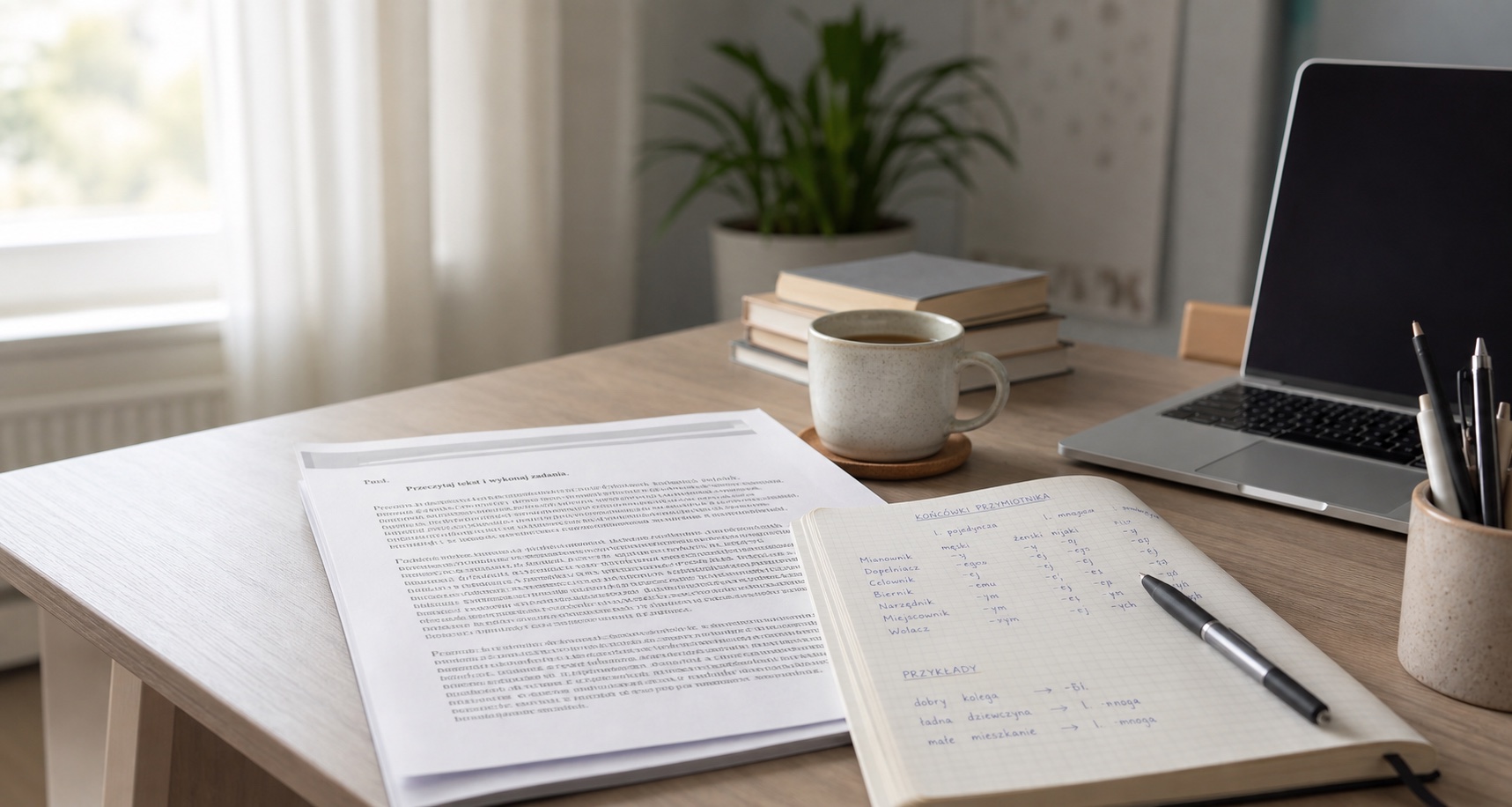
Key information
Check readiness with unfamiliar tasks, one skill at a time. A quiz score or a comfortable conversation is not enough. Time your attempt, check the answers, and discuss writing and speaking with a teacher. Use the results to choose your next exercises, not to predict a guaranteed pass.
1. Getting your message across is a starting point
Everyday conversations often let you choose familiar topics, use gestures and ask for repetition. Those skills matter, but the exam also requires you to follow instructions, produce a text and finish within a time limit.
Adult B1 requires at least 50% in each component. Assess skills separately: strong listening cannot compensate for weak writing.
2. Make your practice attempt meaningful
Choose an official adult B1 sample test you have not attempted before. Prepare the paper and audio, and keep the answer key out of reach until you finish. Follow that test’s timing and instructions.
If you only have half an hour today, attempt one section and label it as a partial check. It can reveal a difficulty, but it does not show how you perform throughout the written exam.
- Work without a dictionary, translator, hints or answer key.
- Play the audio as instructed; save extra pauses and replays for learning afterwards.
- Record when you finish each component. Do not count answers added after the time limit.
- Mark closed questions using the key. Keep your written text and speaking recording for feedback.
3. Check all five skills
For each skill, record whether you can complete a new task without help. In writing and speaking, checking your own work is the beginning of assessment, not a final grade.
| Skill | What to check in practice |
|---|---|
| Listening | Complete tasks for a new recording. After marking, identify whether you missed the main message, a detail or the thread of the conversation. Read the transcript only afterwards. |
| Reading | Complete a new text within the time limit. For an incorrect answer, find the sentence that rules it out and the passage supporting the correct choice. |
| Grammar | Supply forms without a list of options. Check whether you can use the same structure in a new sentence rather than recognise a familiar example. |
| Writing | Write the whole required text. Check the recipient, text type, every instruction point and length. Ask a teacher to assess it against the task criteria. |
| Speaking | Record yourself completing a sample speaking task. Also practise a conversation with someone else. Ask for feedback on clarity, task completion and responses to questions. |
4. Record the result and the reason for each error
Note the date and test, skill, score according to the key, time, any help used, and one problem to address. For writing and speaking, leave room for feedback rather than awarding yourself an exam grade.
Example: “Reading: 7/10 on this exercise, three minutes over time; twice I confused the author’s opinion with another person’s quoted opinion. Next step: in a new text, identify who expresses each opinion.” This describes one exercise, not a complete component or a prediction of passing.
5. What should you do with your results?
Consider accuracy, independence and timing together. If you only find the correct answer after translating or checking for a long time, the task still needs practice.
- Missing evidence: an untested skill is not a passed skill. Arrange a short attempt to fill the gap.
- Foundations need work: if you cannot understand instructions or start a response, return to simpler tasks and ask a teacher to help set priorities.
- Inconsistent performance: if success depends on a familiar topic or extra time, practise the specific difficulty and check it on new material.
- Repeatable performance: several new attempts completed independently and on time, supported by feedback on writing and speaking, provide stronger evidence of readiness. They still do not guarantee a pass.
6. What creates a false sense of readiness?
Repeating a familiar test is useful revision. To check progress, also use new tasks of comparable difficulty.
- A high average with one clearly weaker skill.
- A memorised answer key or a text learned for just one topic.
- Counting only easy questions and ignoring blanks.
- Treating a short test, automated assessment or confidence as a complete exam result.
7. Choose one concrete next step
Choose your weakest skill, one task and a specific goal. Replace “improve my Polish” with “write a new email, cover every point in the instructions and ask for feedback on task completion”. Revise it after feedback, then try a different topic.
Match your next steps to the time remaining. With several weeks, practise weaker areas and repeat the assessment. With three days left, focus on familiar task types, instructions and organising your work.
Frequently asked questions
Does using Polish every day mean I am ready for B1?
It is valuable practice, but also check reading, listening, grammar and writing in the exam format. Everyday conversation does not cover every requirement.
Does 50% in a practice test mean I will pass?
No. Each component matters, as do the conditions and whether you repeat the result on new tasks. A score close to the threshold leaves little room for a harder topic or mistakes.
Can I assess my own writing and speaking?
You can check instructions and notice some errors. Feedback from a teacher familiar with the exam gives a more reliable picture. A recording or model answer alone does not replace assessment.
Is a short PDF test enough for self-assessment?
It helps you find something to practise, but covers only a selection of skills. Add a fuller practice attempt, your own written text and a spoken response.
Official sources
Exam rules and available materials checked on 20 October 2026. This guide concerns adult B1. The self-assessment method and study advice are editorial suggestions from MyPolishExam, not an official readiness scale.
- State Commission: exam structurecertyfikatpolski.pl
- State Commission: sample testscertyfikatpolski.pl
How we prepare our guides
MyPolishExam, a platform operated by Artur Starosz AS Project, is responsible for these guides. We use AI to help develop the texts and translations. We compare information about the exam format with the official sources listed in each article. Examples, exercises and explanations are learning materials; we do not present them as assessments or recommendations from an examination board.
Report an issue with this materialPut the plan into practice
Try a task, review your mistakes and choose what to practise next.
Go to written exam practice