
Polish B1 · adult certificate exam
B1 Polish grammar: 10 errors to fix before the exam
Check ten constructions and learn to explain your own corrections.
Key information
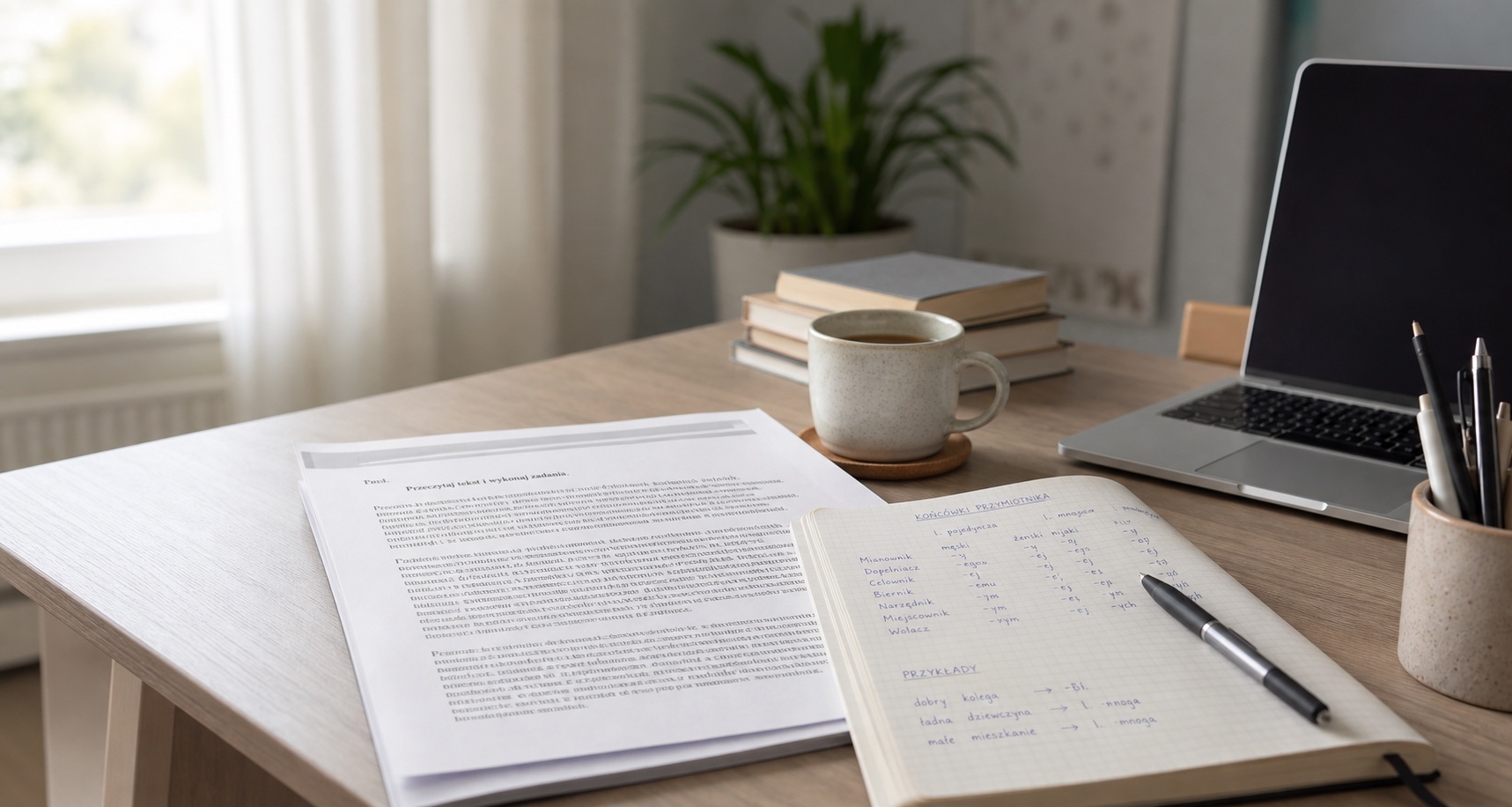
Before the B1 exam, revise grammar in complete sentences: establish the meaning, find the word that requires a particular form, then choose the ending. Below you will practise cases, prepositions, aspect, agreement and sentence linking. This is our revision selection, not an error-frequency ranking or the full B1 syllabus. The examples and exercises are original; official materials appear in the sources.
1. Keeping the accusative after negation
In a simple negative sentence, a direct object that is accusative in the affirmative changes to the genitive. Compare mam dokument and nie mam dokumentu. Change the noun’s modifiers too.
Error to correct → Correct version
Nie mam ważny dokument.
→ Nie mam ważnego dokumentu.Here, the negated verb nie mam requires the forms ważnego dokumentu.
Wybierz poprawne uzupełnienie: Nie widzę ___.
- tego autobusu
- ten autobus
- tym autobusem
Check the answer and explanation
tego autobusu
After nie widzę, use the genitive: tego autobusu. Both words change form.
2. Using the nominative after do or origin-related z
Learn each preposition with its case and meaning. Do indicating a destination takes the genitive. So does z when answering skąd, meaning where from. Z behaves differently when it means with whom, so identifying the preposition alone is not enough.
Error to correct → Correct version
Jadę do Warszawa.
→ Jadę do Warszawy.After do, the name Warszawa takes the genitive form Warszawy.
Wybierz poprawne uzupełnienie: Wracam z ___.
- Kraków
- Krakowa
- Krakowem
Check the answer and explanation
Krakowa
Wracam z Krakowa answers where from, so the genitive is required.
3. Missing the locative when describing a location
When w describes a location, use the locative. Check both the noun and adjective endings; sometimes the word stem changes too. Record whole phrases rather than an isolated ending. Do not automatically extend this rule to every use of w, including expressions of time.
Error to correct → Correct version
Mieszkam w duże miasto.
→ Mieszkam w dużym mieście.W dużym mieście describes a location. Both words are in the locative.
Wybierz poprawne uzupełnienie: Uczę się w ___.
- nowa szkoła
- nową szkołę
- nowej szkole
Check the answer and explanation
nowej szkole
W nowej szkole is singular locative: it identifies the place of study.
4. Using a nominative profession after być
In the construction a person is someone, the profession takes the instrumental. An adjective accompanying it must also have the appropriate form. Distinguish this from to jest ktoś, which uses the nominative.
Error to correct → Correct version
Anna jest nauczycielka.
→ Anna jest nauczycielką.After Anna jest, the profession uses the instrumental: nauczycielką.
Wybierz poprawne uzupełnienie: Piotr jest ___.
- dobry kucharz
- dobrym kucharzem
- dobrego kucharza
Check the answer and explanation
dobrym kucharzem
Dobrym kucharzem is instrumental; both the noun and adjective change.
5. Using the accusative instead of the dative after pomagać
Not every verb takes the accusative. Pomagać and dziękować take the dative, answering komu. With a new verb, record its case question and an example.
Error to correct → Correct version
Pomagam moją siostrę.
→ Pomagam mojej siostrze.Mojej siostrze is the dative required by pomagam.
Wybierz poprawne uzupełnienie: Dziękuję ___.
- miłego sąsiada
- miłym sąsiadem
- miłemu sąsiadowi
Check the answer and explanation
miłemu sąsiadowi
Dziękuję komu? Miłemu sąsiadowi. Both endings are dative.
6. Using perfective aspect for an unfinished action
Choose aspect from the meaning of the whole statement. Pisać describes an ongoing or repeated action; napisać presents it as a completed whole. A time expression alone does not settle everything.
Error to correct → Correct version
Wczoraj przez godzinę napisałam list, ale go nie skończyłam.
→ Wczoraj przez godzinę pisałam list, ale go nie skończyłam.Pisałam fits work on a letter that was not finished.
Marta nadal pisze wiadomość. Jeszcze jej nie skończyła. Wybierz opis trwającej czynności: Marta ___ wiadomość.
- pisze
- napisze
- napisała
Check the answer and explanation
pisze
Pisze describes an action happening now. The alternatives indicate the future or a completed past action.
7. Mismatched gender in the past tense
In the plural, distinguish masculine-personal from non-masculine-personal forms. Two women były, whereas Piotr and Anna byli. First establish who the sentence refers to, then check the verb.
Error to correct → Correct version
Anna i Marta byli w kinie.
→ Anna i Marta były w kinie.Anna and Marta are two women, so the required form is były.
Wybierz poprawne uzupełnienie: Piotr i Anna ___ wczoraj w domu.
- były
- byli
- był
Check the answer and explanation
byli
The group Piotr and Anna requires the masculine-personal form byli.
8. Leaving który uninflected
Który takes its gender and number from the noun it describes, but its case comes from its role in the relative clause. Look for two clues: what the pronoun refers to and which case the following verb or preposition requires.
Error to correct → Correct version
To jest książka, który polecam.
→ To jest książka, którą polecam.Książka is feminine, and polecam takes the accusative: którą.
Wybierz poprawne uzupełnienie: To jest kolega, z ___ pracuję.
- który
- którego
- którym
Check the answer and explanation
którym
Z którym requires the instrumental; the pronoun refers to kolega.
9. Double comparison
Do not add bardziej to a form already in the comparative, such as szybciej. Also distinguish an adjective describing a noun from an adverb describing how something happens.
Error to correct → Correct version
Ten pociąg jedzie bardziej szybciej niż autobus.
→ Ten pociąg jedzie szybciej niż autobus.Szybciej is already comparative; bardziej is unnecessary here.
Użyj stopnia wyższego przysłówka dobrze: Mówię po polsku ___ niż rok temu.
- lepszy
- lepiej
- najlepiej
Check the answer and explanation
lepiej
The comparative of the adverb dobrze is lepiej, not the adjective lepszy.
10. Using bo instead of żeby to express purpose
Bo introduces a reason; żeby can introduce a purpose. When both actions have the same performer, żeby can be followed by an infinitive. Check whether you mean why or for what purpose.
Error to correct → Correct version
Zapisuję słowa, bo ich nie zapomnieć.
→ Zapisuję słowa, żeby ich nie zapomnieć.The purpose of writing words down is not forgetting them, so żeby and an infinitive fit.
Wybierz poprawne uzupełnienie: Uczę się regularnie, ___ lepiej rozumieć rozmowy.
- bo
- więc
- żeby
Check the answer and explanation
żeby
Żeby lepiej rozumieć states the purpose of studying regularly.
Frequently asked questions
Do these ten points cover all B1 grammar?
No. This is a selected revision list. Official materials include other constructions and task types. Complete the grammar section of a sample paper and add the topics you find difficult to your own list.
How can I practise without merely memorising answers?
First hide the corrected version. Explain the rule, do the exercise, then write a new sentence with a different noun or person. Return to it after a few days. Recognising a familiar example is not enough.
What if two choices seem correct?
Read the full instruction and context. Check meaning, required case, tense and person. In our exercises, choose from the supplied options. In other sentences, different forms may be correct but change the meaning.
Does a good exercise score mean I am ready for the exam?
No. Ten short tasks cannot measure your entire level or every exam component. Use them to guide further study, then try an official paper and review your writing and speaking as well.
Official sources
Exam rules checked against official sources on 23 September 2026. Follow the detailed instructions in your chosen paper and from your examination centre.
- Official B1 sample tests for adultscertyfikatpolski.pl
- Official B1 task collection: grammatical accuracycertyfikatpolski.pl
- 2020 B1 sample paper: grammar sectionwww.certyfikatpolski.pl
Put the plan into practice
Try a task, review your mistakes and choose what to practise next.
Practise B1 grammar in MyPolishExam