
Adults · revision at B1 level
Polish B1 exam: a 30-day revision plan
Thirty days to organise what you know, find the gaps and practise the tasks that need your attention most.
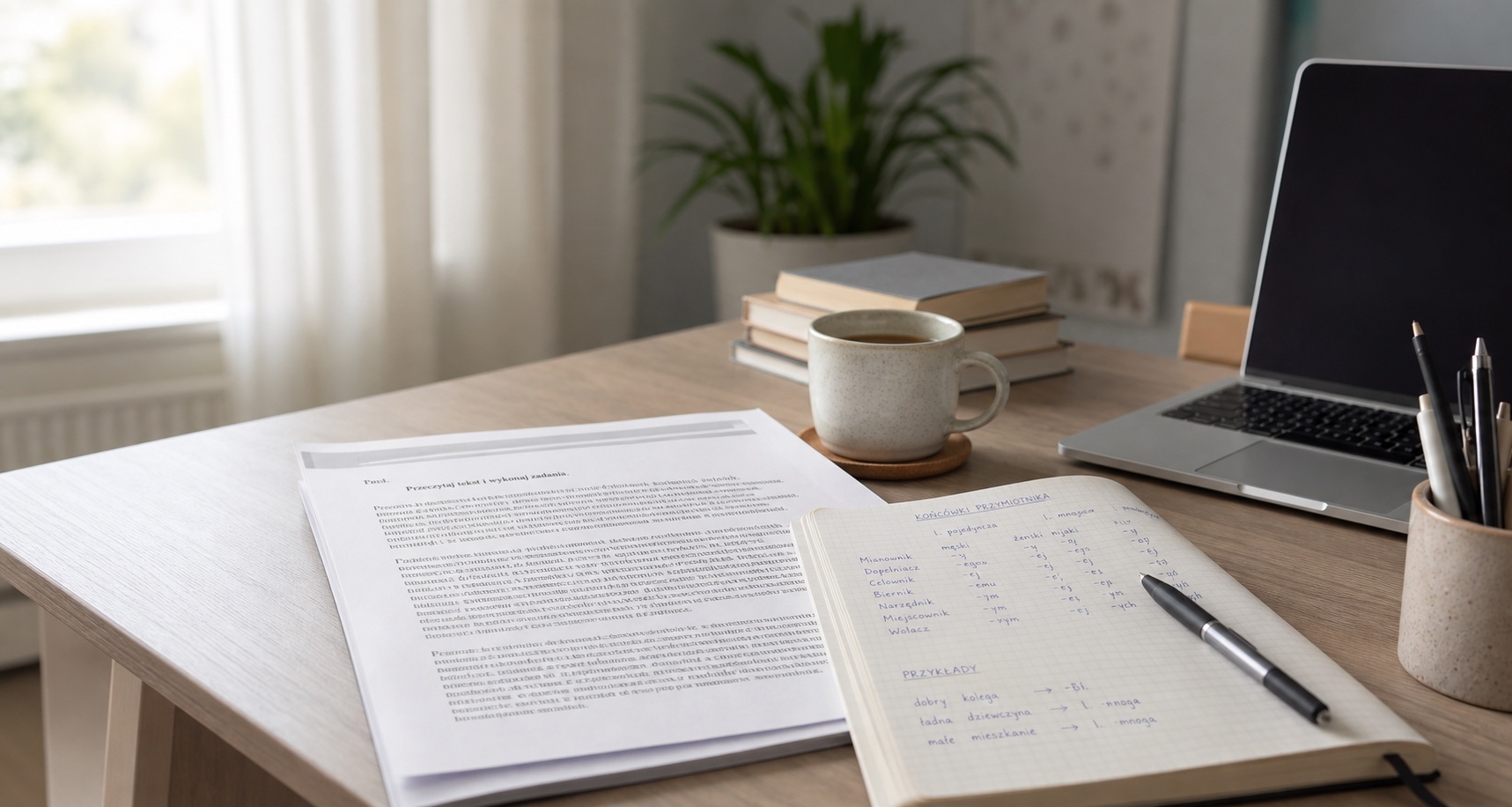
The plan at a glance
To revise for the Polish B1 certificate exam in 30 days, start with a diagnostic session, rotate all five exam skills, keep an error log and complete a timed mock exam. Allow 60–90 minutes on most days and a longer session for the full paper. This plan is for adults already studying at approximately B1 level.
Who is this plan for?
Use this plan if you can already manage everyday conversations in Polish, understand the main points of straightforward texts and write a short connected message. Thirty days is a revision window, not a promise of reaching B1 from scratch or passing the exam.
On day 1, find your weakest areas. Give them more of your practice time while keeping all five skills in the schedule. If even short B1 tasks feel inaccessible, extend your preparation and work on the foundations with a teacher.
What does the adult B1 exam include?
The state Polish B1 certificate exam for adults includes listening, reading, grammatical accuracy, writing and speaking. The written part lasts up to 190 minutes: listening 25, reading 45, grammar 45 and writing 75 minutes. Speaking lasts up to 15 minutes. You need at least 50% in each part; a strong result in one does not compensate for a result below the threshold in another. These are official exam rules, not a forecast of your result.
State certificate exam: structure and pass thresholdsA realistic daily routine
A typical session below takes about 70 minutes. Shorten or extend the main task to fit a 60–90-minute window. The mock exam on day 28 needs a separate, longer slot.
- 10 minutes
- Recall yesterday’s mistakes and useful expressions without looking at your notes.
- 25 minutes
- Complete the main task for the day. On timed days, stop when your chosen limit is reached.
- 15 minutes
- Practise a second skill: a short text, recording or grammar exercise.
- 10 minutes
- Speak aloud: describe an event, explain a choice or record an answer in Polish.
- 10 minutes
- Check answers, explain each correction and add two or three useful examples to your error log.
Your 30-day revision calendar
60–90 min on most days
Day 1–7
Find the gaps
Build a starting point and identify the tasks that cost you the most points.
Day 1: Run a diagnostic session
Try a short sample from each exam skill. Record a two-minute spoken answer and write a short message. Note what caused difficulty; a partial sample is not a full mock-exam score.
Day 2: Read for meaning
Read a short notice and a longer everyday text. Underline the evidence for each answer. Check unfamiliar words after your first attempt.
Day 3: Listen with a clear purpose
Use an official sample recording and follow its instructions. After checking your answers, use the transcript to find the words or details you missed.
Day 4: Review cases in context
Revise common prepositions and the cases they require. Write ten sentences about travel, work or shopping, then explain and correct your mistakes.
Day 5: Write an everyday message
Practise an email or invitation. Before writing, identify the recipient, purpose and required points. Check task completion before correcting grammar.
Day 6: Record a spoken answer
Describe a photograph or a familiar situation, then give an opinion with a reason. Listen to your recording and improve three unclear sentences.
Day 7: Review the first week
Retry selected tasks without the answer key. Choose two priorities for the next week. Keep one corrected example for each recurring error.
Day 8–14
Build accuracy and complete the task
Practise the same skills in different contexts and make corrections you can reuse.
Day 8: Connect grammar to a story
Revise past and future forms and common verb-aspect pairs in context. Describe what happened yesterday and what you plan to do tomorrow.
Day 9: Read for specific information
Practise matching statements to texts. Look for paraphrases, not only identical words. Explain why each rejected answer does not fit.
Day 10: Listen for practical details
Focus on dates, times, prices, places and changes of plan. After checking the task, replay the difficult section and write down the key information.
Day 11: Plan before you write
Choose a writing task from an official sample. Make a short outline covering every instruction, then write and check the requested length and register.
Day 12: Practise a conversation
Role-play making an appointment, returning an item or asking for information. Practise asking for clarification and responding to an unexpected question.
Day 13: Use mixed tasks
Combine a reading task with grammar from its topic. Finish with a short spoken summary. Keep a record of errors rather than only a percentage score.
Day 14: Repeat your weakest tasks
Return to the two priorities chosen on day 7. Compare accuracy, time and independence. If you still need the key to explain an answer, revisit the rule.
Day 15–21
Work towards exam pace
Add time limits gradually without sacrificing understanding.
Day 15: Time a reading task
Choose a section and set a proportionate time limit. Mark uncertain answers and move on. Afterwards, separate vocabulary problems from time-management problems.
Day 16: Complete a listening section
Follow the sample paper and recording instructions exactly. Avoid extra pauses during your attempt. Replay difficult passages only during the review.
Day 17: Write a complete chosen set
Follow the instructions in the official paper: choose one writing set and complete both tasks in that set. Reserve up to 75 minutes, with extra review afterwards if needed.
Day 18: Repair repeated grammar errors
Select three recurring patterns from your log. Write new examples and then complete a short exercise without notes. Explain why the correct forms are needed.
Day 19: Rehearse speaking
Use sample oral tasks with a partner or teacher, or record yourself. Practise description, conversation and an opinion supported by an example.
Day 20: Combine two skills under time pressure
Complete reading and grammar tasks with a planned limit. Leave a moment to check unanswered items. Review whether haste or lack of knowledge caused errors.
Day 21: Check progress and adjust
Compare your work with day 1. Ask a teacher or capable partner to review a written and spoken sample if possible. Prioritise the weakest skill for the coming days.
Day 22–28
Rehearse the exam
Use official sample papers to practise the instructions, timing and transitions.
Day 22: Read every instruction carefully
Review task types in an official paper. Practise identifying what must be selected, matched or written. Pay attention to the writing-set choice.
Day 23: Strengthen listening and reading
Choose tasks similar to those you found hardest. First attempt them under the stated conditions, then identify the exact evidence for the correct answers.
Day 24: Improve a written answer
Rewrite an earlier text without copying the corrected version. Check the purpose, all required points, paragraph order, connectors, spelling and endings.
Day 25: Practise an unfamiliar speaking prompt
Pick a new topic. Organise your answer around a main point, a reason and an example. Practise continuing after a mistake instead of restarting.
Day 26: Review your personal error list
Revisit the patterns that still recur. Cover the answers, correct the original sentences and make a new example. Keep the final revision list short.
Day 27: Prepare for the mock exam
Choose an official B1 paper with recordings and keys. Arrange a quiet space, a timer and the necessary materials. Read the instructions without solving the tasks.
Day 28: Take a full mock exam
Allow up to 190 minutes for the written paper and up to 15 minutes for speaking, plus breaks and later review. Follow the official instructions; assess each part separately.
Day 29–30
Review and rest
Finish with focused corrections and practical preparation.
Day 29: Analyse the mock exam
Check objective tasks with the key. Review writing and speaking against the official criteria, ideally with a teacher. Identify the few changes most likely to help your next attempt.
Day 30: Keep the final revision light
Spend 20–30 minutes on your personal checklist and useful expressions. Confirm the exam location, required documents and arrival time with your centre. Leave time to rest.
How to track your progress
Keep a simple log: date, task, result, reason for the mistake and one corrected example. For objective tasks, write both the number correct and the total. Compare tasks of similar difficulty.
Revisit errors after two days and again about a week later. A correction is useful when you can apply it in a new sentence or task without looking at the answer.
Treat practice scores as learning signals. AI feedback and self-assessment can help you revise, but they do not replace an examiner’s assessment or guarantee a certificate. Ask for external feedback on writing and speaking when possible.
The final two days
Avoid adding a large new topic at the end. Use day 29 to understand your mock-exam mistakes and day 30 for a brief review and rest. If one part remains substantially weaker, plan further preparation rather than relying on your stronger parts to compensate.
Frequently asked questions
Can I reach Polish B1 in 30 days from zero?
This plan is designed for revision by learners already near B1. Beginners need a longer learning pathway. The time required depends on your starting point, previous experience and study conditions.
How much should I study each day?
Aim for 60–90 minutes on most days and adjust to your needs. A full writing set can take 75 minutes before review. Day 28 requires up to 190 minutes for the written mock exam and up to 15 minutes for speaking, plus breaks and analysis.
Do I need 50% overall to pass the adult B1 exam?
You need at least 50% in each part of the adult B1 exam. A total average of 50% is not enough if one part is below the required threshold. See the official exam structure linked below.
Can I skip speaking while revising?
No. Speaking is part of the certificate exam. Practise with a teacher or partner, or record yourself. The speaking module in MyPolishExam is not currently included in the offer; the activities in this plan can be done outside the platform.
Where can I find official B1 practice papers?
Use the official certyfikatpolski.pl collections linked below, including past papers, recordings and answer keys. Follow the instructions in the selected paper and keep official exam information separate from your practice results.
Official sources
Exam information checked on 23 September 2026. Confirm practical arrangements with your examination centre. The study schedule and time suggestions are our own.
- State certificate exam: structure and pass thresholdscertyfikatpolski.pl
- Adult B1 exam: the detailed timing tablecertyfikatpolski.pl
- Official papers from previous yearscertyfikatpolski.pl
- Official sample tests and task collectionscertyfikatpolski.pl
Put the plan into practice
Try a task, review your mistakes and choose what to practise next.
Try a free B1 practice task